

Petition Collecting signatures Federal To: Bundesversammlung, Parlamentsdienste, Parlamentsgebäude, CH 3003 Bern
We want a parliamentary commission of inquiry into the F-35 procurement
Gesponsert von Beat W. Meier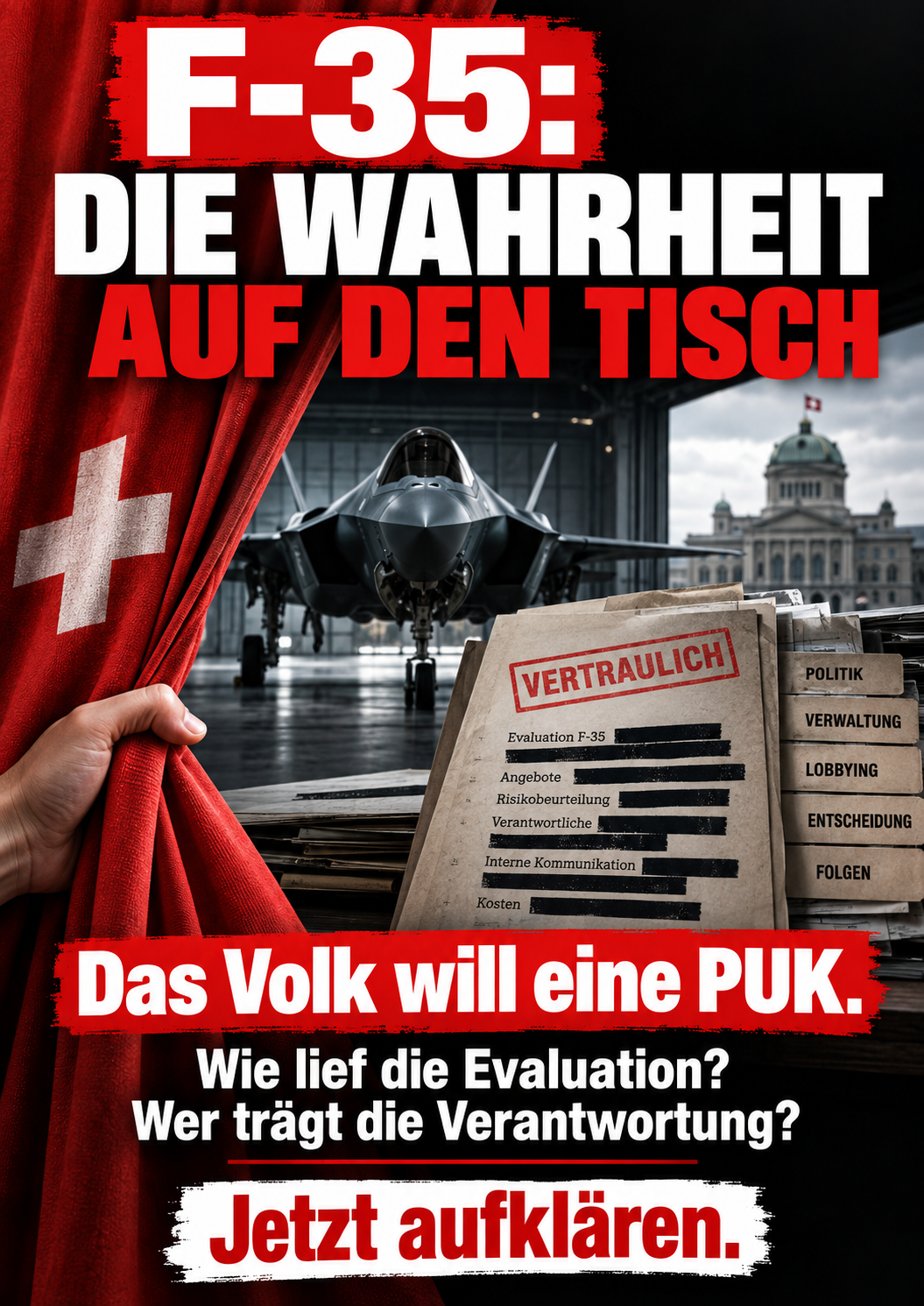
The initiator has chosen not to publish the figures.
We call on Parliament to establish a Parliamentary Commission of Inquiry (PUK) into the procurement of the F-35 fighter jet, with extended investigative powers. We thereby support parliamentary initiative 26.463, which calls for precisely this inquiry in the Council of States.
New in the Council of States: parliamentary initiative 26.463
On 30 September 2026, SP member of the Council of States Franziska Roth (Solothurn) submitted parliamentary initiative 26.463, “Parliamentary Commission of Inquiry into the F-35: Restoring Trust”. It was co-signed by six other SP members of the Council of States and one Green member. The initiative calls for a parliamentary inquiry into weaknesses in the decision and evaluation process for the F-35A—exactly what this petition demands.
This petition supports parliamentary initiative 26.463. Every signature shows Parliament that many people want this investigation.
Read initiative 26.463 on parlament.ch (external link)
Fixed-price assurances and unresolved cost risks
In November 2021, the armasuisse project manager spoke of a fixed price, meaning an all-inclusive fixed price. In June 2022, the committee spokesperson told the Council of States: The agreed prices are fixed. In September 2022, the head of the DDPS assured the National Council that the contract contained fixed prices and also covered inflation in the United States. As recently as June 2025, her successor said: We believe it is a fixed price.
Pricing by production lot does not provide certainty about the total price. The relevant prices are those negotiated by the US government with industry for each lot. The “no profit – no loss” principle means that the US government should make neither a profit nor a loss. Equal pricing within a lot does not guarantee an unchanging total price for Switzerland.
The potential additional costs of CHF 650 million to CHF 1.3 billion announced in summer 2025 are an estimate, not a binding ceiling. A price agreement for Lot 19 does not set the prices for subsequent Lots 20 to 22. Their prices were still open in the published DDPS documents accompanying the 2026 Armed Forces Dispatch. Until the remaining lots have been fully negotiated, the final procurement cost remains uncertain.
There are also uncertainties about the scope of the aircraft's capabilities. Capabilities originally planned for the Block 4 modernisation programme have been postponed to the 2030s or transferred to later development programmes. It must be clarified whether necessary upgrades to the Swiss aircraft are fully covered by the agreed scope or must be paid for separately. Additional costs could result; their amount is unknown.
The voters decided on a false basis
On 27 September 2020, voters approved the procurement by a razor-thin 50.1%, based on the information presented to them. Six billion francs was said to be the ceiling. Today, that amount is not even enough for 30 aircraft.
“Taken together, the information pointed against an understanding of the price as an all-inclusive fixed price at all times.”
At all times. The administration could have known; Parliament could have asked. Voters could do neither.
Why the parliamentary control committee is not enough
The parliamentary Control Committee (GPK) has legally limited powers. It cannot question anyone under a duty to tell the truth; a Parliamentary Commission of Inquiry can. The fact that the GPK found no criminal acts does not mean that none occurred.
Central questions remain unanswered:
- How was the correspondence with the US embassy, including its annexes, interpreted and used to support the fixed-price assurances?
- What do the Federal Council minutes from June 2021 show? Why did the head of the department wait months before informing her colleagues?
- What changed between the two versions of the evaluation report, including the editorial instructions from the DDPS?
- What do the raw jet-evaluation data show? No independent body has recalculated them.
- Why were flight hours reduced for the F-35 alone, giving it lower operating costs in the evaluation?
- Are records missing because files were destroyed or changed afterwards? Who ordered this?
- Did participants move to suppliers or subcontractors after the type decision?
Questions the inquiry should answer
Parliamentary initiative 26.463 raises questions in five areas. This petition adopts them here in plain language.
1. Does the aircraft match the mission?
- The requirement was for an aircraft to protect Swiss airspace and perform air-policing duties. Why did the DDPS nevertheless propose a jet built primarily to attack targets on the ground?
- Did the Air Force adjust the requirements so that the F-35 had an advantage from the outset? If so, why was that allowed?
- Why were the evaluation criteria kept secret? Did even the bidders lack knowledge of some criteria that ultimately decided the outcome?
- Was this intended to bypass the Federal Council's specifications and restrict its choice?
- How will political leaders ensure in future that their specifications remain binding throughout the process?
2. Were the costs made to look artificially low?
- At the time of the decision, the F-35 appeared much cheaper than the other jets. Who calculated purchase and operating costs at such a low level, for example by assuming falling production costs and leaving out known additional costs for upgrades, engines and maintenance?
- Were other bidders treated unfairly as a result? What influence did the manufacturer Lockheed Martin have?
- Were documents missing, preventing the GPK from checking the calculation afterwards?
- Where did the talk of a “fixed price” originate? Was it used to reduce the risk surcharge for the F-35 to an unusually low 1.5%?
- Maintenance costs were based on a highly favourable offer for the first ten years. Lockheed Martin has since withdrawn it. Who was misled—deliberately or through lack of competence?
- Why was a 20% reduction in flight hours assumed for the F-35 alone? Was this based on a cockpit said to provide a particularly good overview, even though that claim rests on classified data to which Switzerland has no access?
- Do so few training flights—an average of one and a half per pilot per week—put flight safety and operational readiness at risk? Will they lead to additional costs?
- How much has all this damaged confidence in Swiss procurement, among the public, bidders and their governments?
3. Was the F-35 fully developed when it was evaluated?
- Since the Mirage scandal, Switzerland has followed a rule of evaluating only aircraft whose development and testing are complete. Why was that rule not applied to the F-35?
- Why was armasuisse allowed to evaluate a future F-35 configuration (Block 4) that was only at an early stage at the time and will arrive no earlier than 2033, while the more advanced Gripen E was encouraged to withdraw because it was allegedly not yet operational?
- Older F-35s flew at Payerne in 2019, while the other jets flew in their completed versions. Did this treat the bidders unequally?
- Are the costs of upgrades through 2033 included in current forecasts, or will they come on top?
- The current engine provides too little cooling and power and is due to be improved only by 2032; Switzerland will pay its own share. What will this cost, and were bidders with mature engines disadvantaged?
- How can a process with such major financial consequences be prevented in future?
4. Will our jets remain operational in a crisis?
- Do Swiss F-35s depend on a spare-parts pool shared by all operator countries? Do the parts belong to the United States and are they merely leased? What risks does this create?
- Can sensitive components such as radar, sensors, communications and electronic-warfare systems be maintained and repaired only by the manufacturer in the United States?
- What happens if the United States needs the parts itself during a crisis, for example during a NATO operation in the Baltic region, the Middle East or around Taiwan? Would Swiss jets then have to wait, or in the worst case remain on the ground?
- If so, why was this risk not identified in the evaluation, and how can it be avoided in future?
5. Where did oversight fail?
- Which checks failed, allowing parts of the administration to influence Switzerland's most expensive procurement process without intervention?
- What must change so that such conduct is detected and stopped early—for example, new procedures, an independent armasuisse or more effective oversight?
- How should the GPK be strengthened so that it can examine difficult specialist questions itself without relying on DDPS experts?
- Was the law firm brought in considered a third party? If so, was the agreement with the United States on the protection of classified information breached?
- Who is responsible for the firm's review being merely formal rather than substantive?
- Were the roles of the Air Force as purchaser and armasuisse as evaluator clearly separated?
And anything else that emerges. The inquiry should also be able to investigate further questions that arise during its work, including stealth technology, data transmission, lost orders for Swiss industry, neutrality when servicing aircraft for other countries, aircraft noise and other Air2030 projects.
This is about more than an aircraft
On Switzerland's largest procurement project, hardly anyone at the DDPS had read the purchase contract. If you do not know the facts, you must take everything on trust—and fewer and fewer people now do. The damage extends beyond an arms deal to confidence in the Federal Council, the administration and Parliament.
A parliamentary inquiry will not necessarily uncover everything. But, if well led and supported by independent specialists, forensic experts and experienced investigators, it is the only means of rebuilding lost trust. Anything less merely manages the damage.
This inquiry should be conducted across party lines. The issue is not left versus right, but whether voters can rely on what their authorities tell them.
Our demand
A Parliamentary Commission of Inquiry into the F-35, with extended powers, independent specialist support and full access to all files and minutes. We support parliamentary initiative 26.463 and call on the Council of States and National Council to approve it. Investigate now.
Bundesversammlung, Parlamentsdienste, Parlamentsgebäude, CH 3003 Bern
Petition · Federal
Sign now
Everyone has the right to petition, regardless of age, nationality or place of residence (Art. 33 of the Federal Constitution).
The initiator has chosen not to publish the figures.
- 1Complete the formYour name, place of residence and email.
- 2Confirm your emailYou will receive a confirmation link valid for 48 hours.
- 3Your signature countsIt is counted only after you confirm it.
Supporters
- Ueli Augsburger3006 Bern · CH
- Carsten Neufing6405 Immensee · CH
- Hans Bieri4500 Solothurn · CH
- Evelyn Gmurczyk4500 Solothurn · CH
- Claudia Waser Baur6314 Unterägeri · CH
- Vivek Sharma4600 Olten · CH
- Eva Iten6315 Oberägeri · CH
- Günter Hempen3315 Bätterkinden · CH
- Max Ungricht3145 Niederscherli · CH
- Kilian Mahler6020 Emmenbrücke · CH
- Ella Liniger5430 Wettingen · CH
- Marianne Phillips6314 Unterägeri · CH
- Markus Tschumi3375 Inkwil · CH
- Ursula Heri2545 Selzach · CH
- Luc Nünlist4600 Olten · CH
- Hubert Stöckli8303 Bassersdorf · CH
- Thomas Landolt7148 Lumbrein · CH
- Sandra Bossard8912 Obfelden · CH
- Elisabeth Furrer9444 Diepoldsau · CH
- Beat Meier6405 Immensee · CH
Only people who expressly consented to being listed appear here. Email addresses are never displayed.
Share this campaign
QR code
Scan with another phone to open the page.
Print a poster
Display it or pass it on. The printed QR code leads to this campaign page.
Legal information
Haftungsausschluss
Der Verein Pro.Politique (in Gründung) stellt INITIQ als technische und organisatorische Plattform bereit. Dieser Haftungsausschluss gilt für die Nutzung der Plattform und ihrer Dienstleistungen, soweit zwingendes schweizerisches Recht keine abweichende Regelung vorsieht.
-
Volle Verantwortung der Urheberin oder des Urhebers. Für sämtliche von ihr oder ihm bereitgestellten oder zur Veröffentlichung freigegebenen Aussagen, Forderungen, Texte, Bilder, Fotografien, Grafiken, Videos, Tonaufnahmen, Dokumente, Quellen, Verlinkungen und sonstigen Inhalte ist ausschliesslich und, soweit gesetzlich zulässig, vollumfänglich die Urheberin oder der Urheber der Kampagne verantwortlich und haftbar – nicht der Verein. Dies umfasst insbesondere Bestand, Umfang und Dauer aller erforderlichen Urheber-, Nutzungs-, Lizenz-, Marken- und Persönlichkeitsrechte, Einwilligungen abgebildeter Personen, korrekte Quellenangaben sowie die Rechtmässigkeit auch von bearbeiteten oder KI-unterstützt erzeugten Inhalten. Die Urheberin oder der Urheber sichert zu, dass keine Rechte Dritter und keine datenschutz-, persönlichkeits-, wettbewerbs-, straf- oder sonstigen gesetzlichen Vorschriften verletzt werden. Eigene zwingende gesetzliche Pflichten und eigenes Verschulden des Vereins können dadurch nicht ausgeschlossen oder übertragen werden.
-
Keine Rechtsberatung oder Gewährleistung. Prüfungen, Hinweise, Vorlagen, Fristberechnungen und technische Plausibilitätskontrollen erfolgen nach bestem Wissen, stellen jedoch keine Rechtsberatung, behördliche Vorprüfung oder Zusicherung dar. Der Verein gewährleistet weder Richtigkeit, Vollständigkeit, Aktualität noch Eignung für einen bestimmten rechtlichen oder politischen Zweck. Massgeblich bleiben die amtlichen Erlasse, Publikationen und Entscheide.
-
Keine Erfolgs- oder Wirkungszusage. Der Verein schuldet weder das Zustandekommen einer bestimmten Anzahl Unterschriften noch die Gültigkeit, behördliche Behandlung oder den politischen, rechtlichen, finanziellen oder kommunikativen Erfolg einer Kampagne. Entscheidungen von Behörden, Gerichten, Plattformen und sonstigen Dritten liegen ausserhalb seines Einflussbereichs.
-
Fristen, Formvorschriften und Einreichung. Die abschliessende Kontrolle gesetzlicher Voraussetzungen, Fristen, Formulare, Unterschriften, Stimmrechtsbescheinigungen, Zuständigkeiten und der rechtzeitigen Einreichung obliegt den Kampagnenführenden. Automatisch erzeugte Dokumente und Berechnungen sind vor Verwendung anhand der aktuellen amtlichen Grundlagen zu prüfen.
-
Betrieb und Verfügbarkeit. Der Verein bemüht sich um einen sicheren und zuverlässigen Betrieb, schuldet aber keine ununterbrochene oder fehlerfreie Verfügbarkeit. Wartung, Sicherheitsmassnahmen, höhere Gewalt sowie Ausfälle von Netzen, Hosting-, Zahlungs-, Post-, Behörden- oder anderen Drittdiensten können Funktionen zeitweise einschränken. Eine absolute Sicherheit vor Datenverlust oder unbefugtem Zugriff kann nicht zugesichert werden.
-
Inhalte und Angebote Dritter. Für externe Webseiten, eingebettete Dienste, amtliche Angebote oder sonstige Inhalte Dritter übernimmt der Verein keine Verantwortung. Eine Verlinkung bedeutet keine Billigung. Nach einem hinreichend begründeten Hinweis auf rechtswidrige Inhalte prüft der Verein angemessene Sperr- oder Entfernungsmassnahmen.
-
Freistellung durch Kampagnenführende. Soweit gesetzlich zulässig, stellt die Urheberin oder der Urheber den Verein vollumfänglich von berechtigten Ansprüchen Dritter frei, die aus bereitgestellten Inhalten, fehlenden Rechten oder einer von ihr oder ihm zu vertretenden Rechtsverletzung entstehen. Dies umfasst angemessene Gerichts-, Anwalts-, Abklärungs- und Abwehrkosten sowie rechtskräftig auferlegte Entschädigungen. Eigene Pflichtverletzungen und eigenes Verschulden des Vereins bleiben davon unberührt.
-
Haftungsbeschränkung. Soweit gesetzlich zulässig, ist die Haftung des Vereins für leichte Fahrlässigkeit sowie für indirekte Schäden, Folgeschäden, entgangenen Gewinn, Nutzungsausfall und Datenverlust ausgeschlossen. Unbeschränkt bleibt die Haftung für rechtswidrige Absicht und grobe Fahrlässigkeit sowie in allen Fällen, in denen ein Ausschluss oder eine Beschränkung nach zwingendem Recht unzulässig ist. Zwingende gesetzliche Ansprüche werden durch diesen Text nicht eingeschränkt.
-
Sperrung und Entfernung. Der Verein darf Inhalte oder Kampagnen vorübergehend sperren, entfernen oder deren Bearbeitung aussetzen, wenn konkrete Anhaltspunkte für Rechtsverletzungen, Sicherheitsrisiken, missbräuchliche Nutzung oder Verstösse gegen die Nutzungsbedingungen bestehen. Gesetzliche Aufbewahrungs- und Nachweispflichten bleiben vorbehalten.
-
Anwendbares Recht und Gerichtsstand. Es gilt schweizerisches Recht unter Ausschluss seiner kollisionsrechtlichen Verweisungsnormen. Soweit gesetzlich zulässig, ist ausschliesslicher Gerichtsstand Zug, Schweiz. Zwingende gesetzliche Gerichtsstände, insbesondere zum Schutz von Konsumentinnen und Konsumenten, sowie gesetzliche Zuständigkeiten für ausservertragliche Ansprüche bleiben vorbehalten.
-
Teilunwirksamkeit. Sollte eine Bestimmung dieses Haftungsausschlusses ganz oder teilweise unwirksam oder undurchsetzbar sein, bleiben die übrigen Bestimmungen unberührt. An die Stelle der unwirksamen Regel tritt die zwingende gesetzliche Ordnung; eine weitergehende Haftungsbefreiung wird daraus nicht abgeleitet.
Unterzeichnet: Pro.Politique (Verein)
Verein Pro.Politique (in Gründung) — Legal notice · Privacy · Report content